Stress Fractures in College Sport
671 stress fractures reported across 25 sports over 10 years — 5.70 per 100,000 AEs overall. Football had 57 total foot stress fractures. The rate was 51% higher during preseason than regular season.
High-impact sports expose athletes to greater injury risk. Is there a way to prevent stress fractures by applying the lessons of sports science? Lower Extremity Review Cover Story, 2018.
671 stress fractures reported across 25 sports over 10 years — 5.70 per 100,000 AEs overall. Football had 57 total foot stress fractures. The rate was 51% higher during preseason than regular season.
Average recovery 6–12 months. 67% career-ending injury rate in college football. An average of 18.9 Lisfranc injuries per year in the NFL from 2006–2014. Causes are multifactorial: artificial surface, lighter shoes, bigger players.
42-day median time loss — highest of all foot injuries. Wide receivers, linebackers, and tight ends at highest risk in the NFL. 12% needed repeat surgical procedure. GPS technology can detect early warning signs.
Acute-to-chronic workload ratio monitoring, custom cleat fitting, reduced artificial turf exposure, and movement quality screening offer the best evidence-based approach to prevention.
Traditional risk factors include: rigid/supinated feet, flatter foot landing when jumping, muscle fatigue, hypermobile joints, lack of flexibility, previous injury, muscle imbalances, nutritional issues, sleep deprivation, and poor warm-up. Modern sports science adds: large acute-to-chronic workload ratios, inadequate off-season bone loading, and training after muscle fatigue — which changes foot loading patterns as demonstrated by force plate studies.
Stress fractures of the foot result from repetitive microtraumas and chronic submaximal loading of tissues. Among football players, the most common are the Jones fracture — a break in the fifth metatarsal between the base and the middle — and the Lisfranc fracture, a fracture or dislocation within the Lisfranc joint complex, which stabilizes the midfoot and is critical for walking. If not properly diagnosed, these fractures can lead to significant morbidity and can, for some athletes, be career-ending.
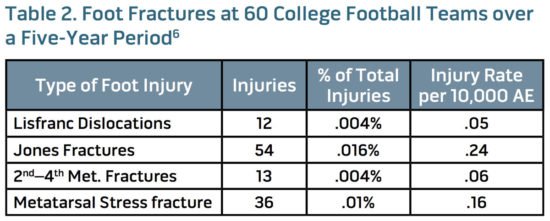
In the most comprehensive evaluation of stress fractures in collegiate athletes to date, Rizzone et al. examined data from the NCAA Injury Surveillance Program covering more than 25 sports from 2004–2005 to 2013–2014. A total of 671 stress fractures were reported after 11,778,145 AEs, for an overall injury rate of 5.70 per 100,000 AEs. Women's cross country, women's outdoor track, and women's gymnastics had the highest stress fracture rates. Football had 57 total foot stress fractures: 50 metatarsal and three navicular. The rate of foot stress fractures in football was 3.01 per 100,000 AEs. The rate of stress fractures was 51% higher during preseason than during the regular season.
Lisfranc Dislocation: Causes are believed to be multifactorial — artificial surface, lighter and more flexible shoes, and bigger/faster/stronger players. Noncontact twisting moves, such as when a defensive end engages with an offensive lineman, are a common cause. Average recovery is 6–12 months with discomfort possible for over a year. In the NFL, there were an average of 18.9 Lisfranc injuries from 2006 to 2014. Lisfranc dislocations accounted for the second highest percentage of career-ending injuries at 67% in college football.
Jones Fracture: Despite being rare, Jones fractures resulted in the highest median time loss at 42 days. Studies show that a decrease in hip internal rotation is related to increased risk. Wide receivers, linebackers, and tight ends had the highest rates in the NFL, with 12% needing a repeat surgical procedure. GPS technology has proven it can provide early signs or symptoms in soccer players.
Navicular Fracture: Very serious — athletes who sustain navicular fractures are twice as likely to remain undrafted and less than half as likely to compete in at least two NFL seasons.
There are many more studies on cleats for soccer than for American football cleats. We know that footwear traction is linked to injury risk because of increases in rotational traction. Studies have shown that bladed cleats produced a greater risk of fifth metatarsal stress fracture with increased forefoot loading during jump-landing tasks. NFL medical staff say bigger, faster, and stronger players, along with lighter and less stable shoes and playing surfaces, could contribute to foot injuries.
While identifying risk factors has long been the norm for sports injury research, a systems-based process appears to be the future — with a focus similar to Fergus Connolly's holistic psychological, physical, technical, and tactical approach. Systems thinking is concerned with the interrelationships between parts and their relationships to a functioning whole. So it is not only bigger and faster players, but custom cleats with custom orthotics and a data-driven training plan. With sports science tools properly utilized, soft tissue, noncontact, and fatigue-based injuries are on the decline. After all, it does not matter how fast you are if you are not on the field.