Article · Injury Mitigation · Research · September 2018
Keeping Up with the Joneses, Lis and Franc: Foot Injuries in College
Jones fractures, Lisfranc dislocations, and stress fractures of the foot in college football — epidemiology, risk factors, case studies, and what sports science can do to reduce their occurrence.
Football had 57 total foot stress fractures over 10 years across college sports. Yet Lisfranc dislocations accounted for the second highest percentage of career-ending injuries at 67%. Jones fractures had the highest median time loss at 42 days.
Risk Factors
Load, Fatigue, and Footwear
Large acute-to-chronic workload ratios, muscle fatigue altering foot loading patterns, lighter and more flexible cleats, artificial turf, and bigger/faster/stronger players are all contributing factors. GPS monitoring can detect early warning signs.
Case Study
Navy's Embedded Approach
After a foot injury epidemic, Navy held a summit, partnered with Under Armour for individual cleat fitting, reduced artificial turf exposure, added foot-specific warm-ups, and implemented Fusionetics. Result: just one foot injury the entire following season.
Systems Thinking
Holistic Prevention
Identifying single risk factors is no longer sufficient. A systems-based approach — custom cleats, orthotics, data-driven load management, sleep, nutrition, and movement quality — offers the best path to reducing foot injuries in football.
Full Article
With the 2017 holiday season upon us, it is time to discuss family with the hope that the family members Jones, Lis, and Franc of the Foot family do not show up at your house. Since Lisfranc injuries occur in the midfoot, Lis and Franc are actually together and always in the middle of arguments without much support from others. Jones is the outsider at the edge of the family, hence the 5th metatarsal fracture on the lateral side of the foot. All of them do not respond well to too much stress and will break down, usually at the holidays — or literally before a big game.
Rate of Stress Fractures in 25 Sports in College Athletes Over 10 Years
In the most comprehensive evaluation of stress fractures in collegiate athletes to date using data from the NCAA Injury Surveillance Program covering over 25 sports from 2004–05 to 2013–14, a total of 671 stress fractures were reported after over 11,778,145 athlete-exposures (AEs), for an overall injury rate of 5.70 per 100,000 AEs. Women's cross country, outdoor track, and women's gymnastics had the highest stress fracture rates. Football only had 57 total foot stress fractures: 50 metatarsal and only 3 navicular.
With sports science, we are learning that a large acute-to-chronic workload ratio at the beginning of the season, along with a lack of proper bone loading in the offseason, can lead to a higher risk of stress fractures. The rate of stress fractures was 43% higher during preseason than during the regular season. Chronic overload can lead to stress injuries, most commonly due to fatigue rather than actual bone structure issues — but only constitutes 2% of total football injuries.
Incidence and Severity of Foot and Ankle Injuries in Men's Collegiate Football
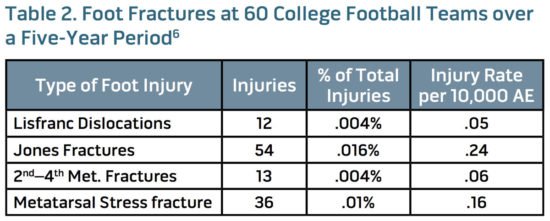
In a 2015 study, injury data were obtained from 60 of the 616 NCAA teams over five football seasons (2004–2009), encompassing over 2,222,155 AEs. Results showed a total of 3,326 foot and ankle injuries, with an injury rate of 14.97 per 10,000 AEs. Foot injuries more frequently resulted in failure to return to play (98 athletes; 12.2%), with Jones fracture having the highest median time loss at 42 days. Midfoot sprains have been rare in the NFL, with only 15 reported for NFL teams in a study over 15 years.
Table 2: Foot Fractures at 60 College Football Teams over a Five-Year Period — Lievers & Adamic, 2015
Specific Foot Injuries
Lisfranc Dislocation: Average recovery is 6–12 months, with discomfort possible for over a year. Each Lisfranc injury is different — a player can tear one ligament or five, and bone displacement varies. In the NFL, there was an average of 18.9 Lisfranc injuries per year from 2006–2014. Causes are believed to be multifactorial: artificial surface, lighter and more flexible shoes, and bigger/faster/stronger players.
Jones Fracture: Despite being rare, Jones fractures resulted in the highest median time loss at 42 days. Studies show that past lower extremity injuries and muscle imbalances can increase risk — a decrease in hip internal rotation has been related to increased risk. Wide receivers, linebackers, and tight ends had the highest rates in the NFL, with 12% needing a repeat surgical procedure.
Navicular Fracture: Very serious — athletes with navicular fractures are twice as likely to remain undrafted and less than half as likely to compete in at least 2 NFL seasons. Rival teams could use this data to dissuade parents from selecting a college with a history of high foot injury rates.
Achilles Rupture: From 1989–2013 there were only 86 Achilles ruptures across the NFL, NBA, MLB, and NHL. In the NFL, 78 occurred between 2010–2015, with 58% in the preseason and 26% of players never returning to play. The pattern suggests that training loads leading into preseason were insufficient, especially with athletes skipping OTAs and resuming explosive actions too quickly.
Case Study #1 — Navy
Navy had four foot or knee injuries in a recent loss to Temple and lost three straight to end the year after starting 9–2, causing the staff to hold a "huge summit." While the summit was a smart step, the question remains: why not start with an embedded department and strong internal communication before reaching that point?
Under Armour went above and beyond to assist Navy by sending employees to spend three days evaluating every player's feet to ensure proper cleat fitting. One major issue uncovered was that many players wore cleats that were not wide enough and compensated by wearing longer cleats. Navy also reduced exposure to artificial turf and added orthotics and foot-specific warm-ups. GPS tracking revealed that an NFL team's artificial turf imposed a 15% greater load on players compared to their grass practice field — resulting in a reduction from 25 to 18 minutes of running in practice.
Update: According to The Denver Post, Navy had just one foot injury reported for the entire 2017 season.
Case Study #2 — Power 5 Team
This Power 5 team invested in state-of-the-art facilities, but the apparent lack of a sports science program and ongoing poor on-field results led to media scrutiny over the number of foot injuries — reportedly 10 bone fractures in a single year. The head coach defended the situation by saying such injuries are common in the NFL and that their numbers were like everyone else's.
This Power 5 team's rate of foot fracture was 5.4 per 10,000 AE — compare that to 0.52 per 10,000 AE in the 2015 study of 60 NCAA teams. In ten years leading up to 2014, there were 115 foot fractures in 60 teams — compared to at least 12 in three years for this one Power 5 team. It almost looks as if this team may have been training like a women's gymnastics program, which has the highest rate of stress fractures due to high loads of repetitive impact.
Systems-Based Holistic Approach
While identifying risk factors has been the norm in sports injury research, a systems-based process appears to be the future — with a focus similar to Fergus Connolly's holistic psychological, physical, technical, and tactical approach. Systems thinking considers the interrelationships between parts and their relationships to a functioning whole.
So it is not only bigger and faster players — it is custom cleats with custom orthotics and a data-driven training plan. Injuries will happen despite the best sports science. But if we can reduce the chances of Jones, Lis, and Franc showing up, it is worth pursuing. After all, it does not matter how fast you are if you are not on the field.